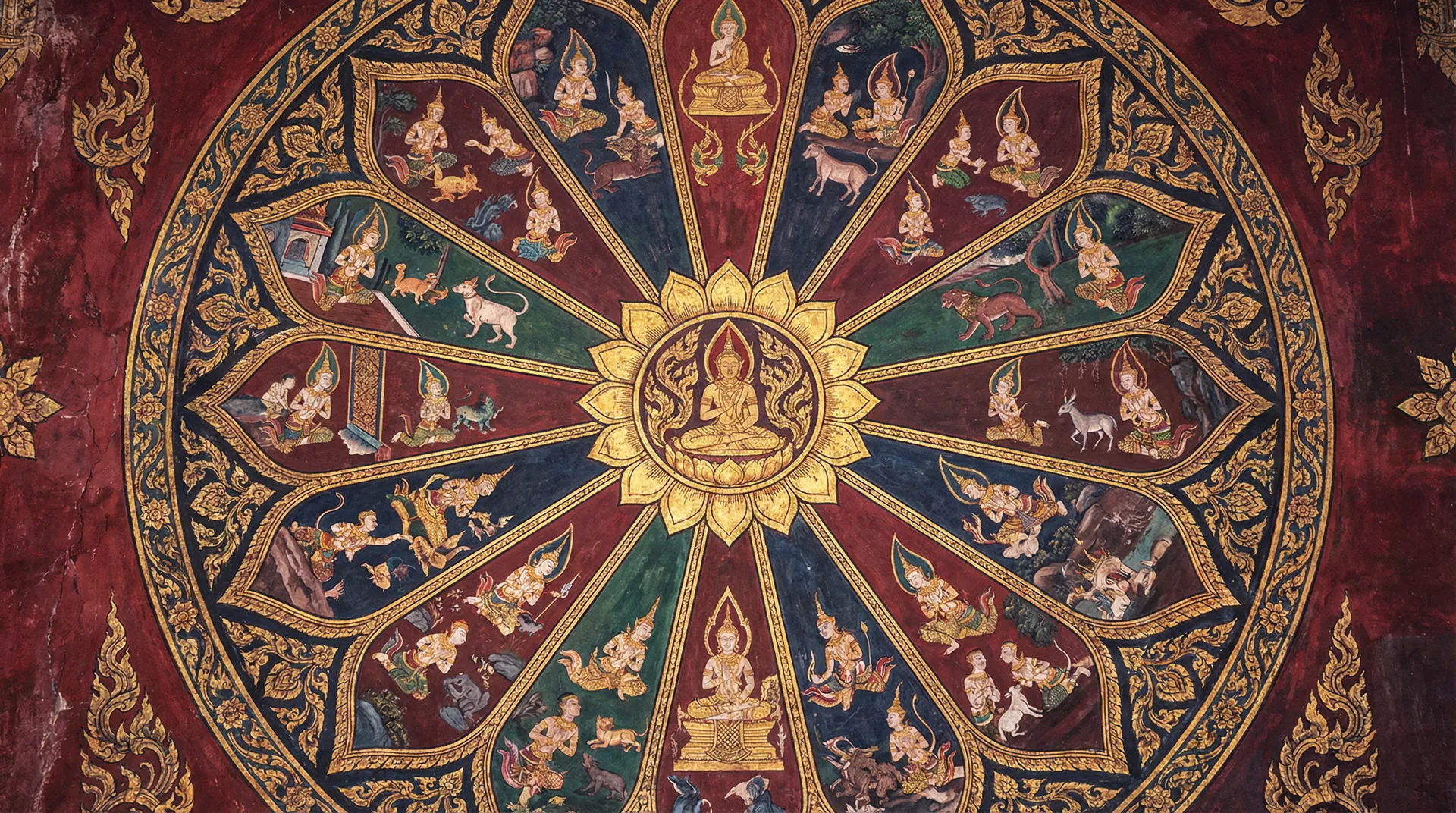
Kusa Jataka
The Prince Who Endured Hardship for Love
Long ago, in the opulent kingdom of Kosala, lived a prince named Bodhisattva, renowned for his virtue and his deep love for his wife, Princess Padmavati. Their union was one of pure bliss, a beacon of happiness for all who witnessed it. However, destiny, as it often does, had a cruel twist in store. The king, Padmavati’s father, a man consumed by pride and a twisted sense of honor, found himself in a bitter feud with the king of Kosala.
The conflict escalated, and in a moment of rash anger, the king of Padmavati’s kingdom declared war. The king of Kosala, a formidable warrior, emerged victorious. In the aftermath, driven by a desire for retribution and a misguided belief that humiliation would teach the vanquished king a lesson, he demanded a steep price for peace. He decreed that the princess, Padmavati, his own daughter-in-law, must be exiled and wander in the wilderness for seven years, her beauty and virtue to be tested by the harsh elements and the solitude of the forest.
Prince Bodhisattva was heartbroken. He pleaded with his father, the king of Kosala, to reconsider, but his pleas fell on deaf ears. The king, bound by his word and his pride, refused to yield. Padmavati, though deeply distressed, accepted her fate with grace and fortitude. With a heavy heart, Prince Bodhisattva watched as his beloved wife, clad in simple garments, was led away into the unforgiving wilderness.
The prince, unable to bear the thought of his beloved suffering alone, secretly vowed to find her and support her from afar. He disguised himself as a humble ascetic, taking on the appearance of a wanderer. He shed his princely robes, cut his hair, and smeared his body with ash, leaving behind the comforts of his palace to embark on a solitary quest.
For seven long years, Prince Bodhisattva wandered through dense forests, climbed treacherous mountains, and navigated desolate plains. He endured hunger, thirst, and the biting cold. His only companion was the burning desire to protect his wife and ensure her well-being. He would often find traces of her presence – a discarded flower, a footprint, a faint scent – and his heart would swell with a mixture of sorrow and renewed determination. He would leave behind small offerings of food or shelter, subtle signs of his care that she might never know were from him.
Meanwhile, Princess Padmavati, though alone, did not despair. Guided by her inner strength and the teachings of the Dhamma, she found solace in nature. She learned to forage for edible roots and berries, to find shelter in caves, and to live in harmony with the wild creatures. Her spirit remained unbroken, her virtue untainted. She often thought of her beloved husband, praying for his well-being and for the day their ordeal would end.
The seven years passed agonizingly slowly. Prince Bodhisattva, now gaunt and weathered, his princely bearing hidden beneath layers of ascetic garb, finally heard whispers of a woman matching Padmavati’s description living in a secluded part of the forest. His heart pounded with anticipation. He followed the trail, his steps quickening with every passing moment.
He found her near a crystal-clear stream, her beauty undimmed by her hardships, her spirit radiant. She was weaving a garland of flowers, her fingers moving with practiced ease. He approached her cautiously, his ascetic disguise still in place. He addressed her with a respectful greeting, and though he looked like a stranger, there was an undeniable familiarity in his eyes. Padmavati, though surprised, felt a strange sense of comfort in his presence.
They spoke for a while, and Bodhisattva, unable to contain his emotions any longer, revealed his true identity. Padmavati’s eyes widened in disbelief, then filled with tears of joy. The reunion was one of profound emotion, a testament to their enduring love. They embraced, their hearts overflowing with gratitude for their reunion and for the strength they had found within themselves.
Upon their return to Kosala, the king of Kosala was deeply ashamed of his past cruelty. He welcomed them back with open arms, offering his deepest apologies. Prince Bodhisattva and Princess Padmavati, their love tested and strengthened by their seven-year ordeal, ruled the kingdom with wisdom, compassion, and a profound understanding of suffering, becoming an inspiration to their people and a living testament to the power of unwavering devotion.
— In-Article Ad —
💡Moral of the Story
True love endures all trials and tribulations. Compassion and understanding are paramount in overcoming conflict and bitterness.
Perfection: Compassion, Patience, Determination
— Ad Space (728x90) —
More Jataka Tales You May Enjoy
 527Mahānipāta
Mahā-susukajātaka
The Tale of the Contented Monkey In a lush, verdant forest teeming with life, where ancient trees sc...
💡 True happiness and contentment are found not in the abundance of external possessions, but in appreciating what one already has and choosing to find joy in the present moment.
 24Ekanipāta
The Bodhisatta as a King
The Bodhisatta as a KingIn the heart of a prosperous and fertile kingdom, known for its bountiful ha...
💡 True leadership inspires generosity, and collective compassion can overcome dire hardships.
115EkanipātaMittavindaka Jātaka
Mittavindaka Jātaka In the bustling city of Savatthi, there lived a wealthy merchant named Mittavind...
💡 Extreme stinginess leads to isolation, regret, and a life devoid of true happiness. Generosity and compassion are the real treasures that enrich life.
76EkanipātaThe Tale of the Fragrant Tree
The Tale of the Fragrant Tree In the heart of a vast and ancient forest, where sunlight dappled thr...
💡 Curiosity, coupled with the courage to learn new things, can lead to great discoveries that benefit society.
 268Tikanipāta
Dhammapala Jataka
Dhammapala JatakaIn the bustling city of Varanasi, where merchants plied their wares and scholars de...
💡 Control your anger and seek the truth before acting; true strength and nobility are found in compassion and understanding, not in fury.
 208Dukanipāta
Masa Jataka
Masa Jataka In the bustling city of Mithila, where artisans toiled and merchants traded, lived a dev...
💡 True wisdom lies not in outward displays of power or prestige, but in the internal cultivation of reverence, respect, and integrity for all beings and all things, no matter how small or seemingly insignificant.
— Multiplex Ad —